A Serviced Label Is Not Enough: A Real Lesson in Fire Suppression Maintenance
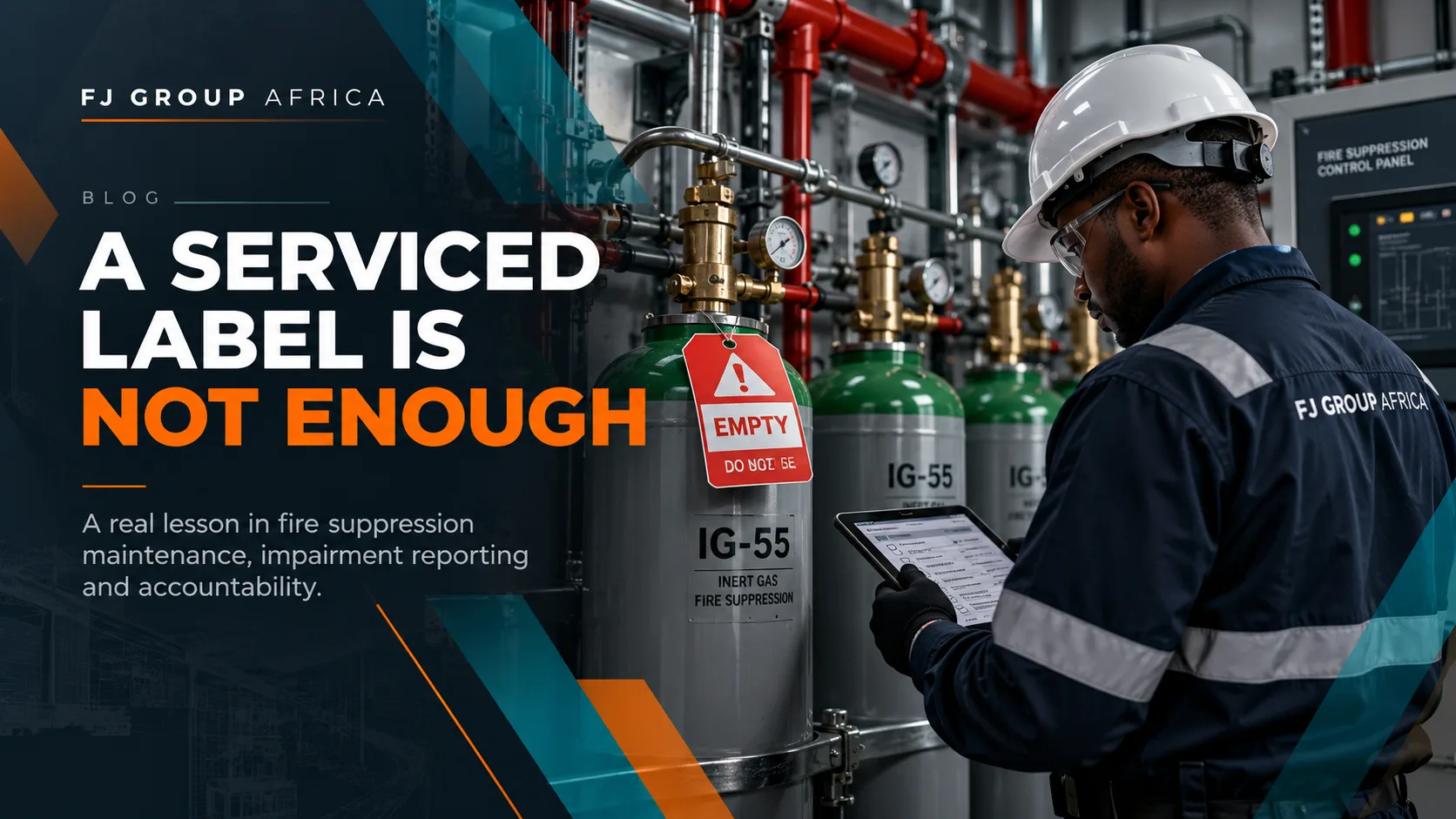
We identified an empty suppression cylinder. We recorded the condition in the service report. But we did not immediately escalate the impairment to the client.
That was not good enough.
At FJ Group Africa, we believe accountability means being willing to discuss where our service fell short—not only where it went well.
This incident highlighted an important distinction in fire detection and suppression maintenance:
Identifying a problem is not the same as communicating its urgency. Recording a defect is not the same as managing the risk.
Our client was right to expect immediate notification. Their concern was justified, and the incident reinforced why an effective quality management system must support the work we perform.
This is what happened, what we learned, and why it matters.
What Happened During the Scheduled Service?
FJ Group Africa was carrying out a client’s scheduled six-monthly fire detection and suppression service.
During the work, an empty-cylinder condition was identified on one of the client’s IG-55 gas fire suppression systems.
The technician carried out the service and applied a serviced label to an empty cylinder. The empty condition was noted in the service reports.
However, those reports were only handed in after all the services had been completed. The issue was not reported immediately, and an impairment notice was not raised when it should have been.
The client was understandably upset.
They should not have had to wait for the complete set of service reports to learn about a condition affecting their fire suppression protection.
The fact that the defect had been written down did not make the delayed notification acceptable.
This was a failure in our escalation and communication process, and we take responsibility for it.
Why an Empty IG-55 Cylinder Is a Serious Finding
IG-55 is an inert gas fire suppression agent. Systems using this agent suppress fire by reducing the oxygen concentration within the protected enclosure. The availability of the extinguishing agent is therefore fundamental to the system’s intended performance. ansul.com
An empty cylinder cannot deliver its intended contribution of extinguishing gas.
The impact on the complete system depends on its design and cylinder arrangement, but an empty cylinder cannot simply be treated as an ordinary maintenance observation. The affected system’s ability to provide its intended protection requires assessment.
Fire protection impairments can expose occupants, emergency responders and property to increased risk. This is why impairment management needs clear responsibilities and action—not just a note in a report.
For us, the lesson was clear:
A finding that affects fire protection must be escalated when it is discovered, not when the paperwork is eventually submitted.
A Service Label Must Not Create False Reassurance
One of the most important aspects of this incident was the serviced label.
A client seeing a recently serviced label could reasonably believe that the equipment had been checked and was ready to perform its intended function.
In this case, that impression would not have reflected the empty-cylinder condition.
There is an important difference between:
“Maintenance work was carried out.”
and
“The equipment is operational and its intended protection has been verified.”
A service label alone does not establish the second statement.
Our responsibility is to make the equipment’s condition clear. A maintenance record and the information presented at the equipment should not leave the client trying to reconcile a reassuring label with a serious defect mentioned elsewhere.
Where protection is impaired, that status must be unmistakable.
The issue is not simply whether a label records a service date. It is whether the overall communication accurately explains what protection is available—and what is not.
Why Immediate Impairment Reporting Matters
An impairment notice communicates that a fire protection system, or part of it, cannot currently be relied upon to perform its intended function.
It allows the responsible people to assess the situation, determine appropriate temporary precautions and arrange corrective work. Prompt notification and management of increased risk are central features of established impairment-management practice.
In our incident, the reporting process allowed an urgent finding to wait for the completion of the wider service work.
That should not have happened.
The full service report and the immediate impairment notification serve different purposes. One provides the detailed maintenance record. The other alerts the client to a condition requiring attention now.
An urgent notification cannot be replaced by a report that arrives later.
The standard we must hold ourselves to is that a serious impairment is directly communicated to the client’s responsible representative, formally recorded and escalated internally without waiting for routine administration to catch up.
Temporary precautions and any restrictions on activities must then be determined through a competent, site-specific assessment. Reporting an impairment does not, by itself, make continued operation safe.
Our Client Was Right to Challenge Us
It would have been easy to focus on the fact that the empty cylinder was recorded in the report.
But that would have missed the point.
The client’s concern was not simply whether we had noticed the problem. It was whether we had communicated it with the urgency it deserved.
They had appointed us to service systems intended to protect their premises. They were entitled to expect clear information about a condition affecting that protection.
“It was in the report” was not an adequate response.
We must assess our service from the client’s perspective as well as our own. What did the client understand about the system’s condition? When did they receive that information? Were they given a clear opportunity to act?
In this instance, our communication fell short.
How FJ Group Africa Responded
Following the incident, FJ Group Africa raised an internal non-conformance report, or NCR, and immediately implemented action aimed at preventing a recurrence.
Raising the NCR was an acknowledgement that the service outcome did not meet the required standard.
However, an NCR should not become another document that is opened, signed and forgotten.
Its purpose is to support a meaningful response: understand the failure, identify its causes, determine the necessary changes and check whether those changes work.
In quality-management terminology, corrective action addresses the causes of an identified nonconformity to prevent it from happening again. Preventive action addresses potential problems before they occur. The distinction matters because correcting one incident and improving the process are not the same task.
For this incident, the questions that matter include:
Why did the reporting process allow an impairment to wait?
Why was the equipment’s impaired condition not communicated clearly enough alongside the service label?
What controls are needed so that urgent findings cannot remain within routine paperwork?
Those questions concern our processes, supervision and communication—not simply the actions of one technician.
FJ Group Africa is responsible for the service delivered in its name.
Why an Effective QMS Matters in Fire Protection
A quality management system, or QMS, is the set of processes and procedures through which an organisation manages the quality of its work. ISO describes effective quality management as involving consistent processes, customer focus and continual improvement—not merely documentation.
For a fire protection company, that system needs to work on site, in real decisions and under everyday operational pressure.
It should help answer questions such as: What must a technician do when a critical defect is identified? Who must be contacted? Who follows up? What evidence is needed before an issue can be closed?
This incident reinforced four priorities for the standard we must maintain.
Immediate escalation must be separate from routine reporting
A technician should not need to complete every service report before communicating a serious impairment.
The process must provide a clear route for urgent notification and further escalation when the first responsible contact is unavailable.
Equipment status must be clear
Clients need to understand whether equipment was inspected, serviced, found defective, impaired or restored.
Our labels, reports and direct communication must support that understanding rather than create conflicting impressions.
An outstanding issue needs a named owner
Identifying a problem is only the beginning.
Someone must be responsible for coordinating the next action, keeping the client informed and ensuring the issue does not disappear between technical, administrative and approval processes.
Improvement needs evidence
Issuing an instruction is not the same as proving that a process has improved.
A QMS should include checking what happens after changes are introduced and acting on the findings. That cycle of planning, implementation, checking and improvement is central to ISO’s explanation of effective quality management.
Closing an NCR Is Not the Same as Restoring Fire Protection
There are two distinct matters to manage after an incident like this.
The first is the physical condition of the fire suppression system.
The second is the failure in the service and reporting process.
Addressing the reporting failure does not refill a cylinder. Equally, restoring the cylinder does not automatically correct the communication weakness that allowed the impairment to go unreported.
Both need attention.
A complete impairment-management process follows the issue from notification through to resolution, rather than treating the initial report as the finish line. FM’s impairment services similarly emphasise tracking impairments until protection is restored.
For our own improvement process, the same discipline is essential: action must be supported by evidence, and closure must mean more than administrative completion.
The paperwork must reflect the condition of the system—not substitute for it.
What Facility Managers Can Learn From This Incident
Although this happened during work performed by FJ Group Africa, the questions it raises are relevant to any organisation appointing a fire detection or suppression maintenance provider.
Before the next service, ask:
“How will you notify us immediately if you identify a system impairment?”
Agree who the responsible contact is and how urgent findings will be escalated. Also establish how impaired equipment will be identified and how outstanding corrective work will be tracked.
When reviewing the service outcome, distinguish between work completed and protection restored.
A report may confirm that maintenance activities took place while also identifying unresolved defects. The important question is whether those findings have been clearly communicated and appropriately acted upon.
Do not judge the outcome only by the presence of a new service label. Ask what the service established about the system’s actual condition.
No Business Is Perfect. That Is Not an Excuse.
We will not pretend that no mistake can ever happen at FJ Group Africa.
But in fire protection, “no business is perfect” cannot be used to minimise a failure.
It is a reason to maintain stronger controls, listen carefully to clients and respond honestly when our service falls short.
In this incident, the client was right to expect better. We raised an internal NCR and implemented immediate action aimed at preventing recurrence.
Our continuing responsibility is to make improvement real.
That means being willing to acknowledge a failure without hiding behind a service report. It means examining the process rather than placing all responsibility on an individual. And it means checking whether the changes we make are effective.
Accountability is not claiming that we never get anything wrong. It is taking responsibility when we do—and doing the work needed to improve.
Our Commitment: Improve Every Day
At FJ Group Africa, we want our commitment to quality to be visible in how we work, how we communicate and how we respond when something goes wrong.
This incident reinforced a principle we must carry into every service:
A critical finding must become an immediate conversation and a managed action—not a delayed discovery in a service report.
We will strive to improve every day.
Not because improvement makes a good marketing statement, but because our clients deserve clear information, accountable service and a company willing to learn.
FJ Group Africa—protecting what matters when every second counts.
For enquiries about fire detection and suppression maintenance, system assessments or the management of outstanding service findings, contact FJ Group Africa.
Frequently Asked Questions
Does a serviced label mean a fire suppression system is fully operational?
Not on its own. A serviced label may record that maintenance work took place, but it does not resolve defects identified during that work. The service findings, impairment status and evidence of completed corrective work must also be considered.
Should an empty suppression cylinder wait for the final service report?
In the incident described here, it should not have. The empty-cylinder condition required immediate impairment notification. The detailed service report should support that notification, not delay it.
Why does a fire protection company need a quality management system?
A QMS helps organise responsibilities, communication, records and improvement. Its value lies in making those processes work consistently, including when a defect or service failure is identified.
What is the difference between an impairment notice and an NCR?
An impairment notice communicates a problem affecting the availability or intended performance of fire protection. An NCR records a failure to meet a requirement within the company’s work or processes. In this incident, the empty-cylinder condition required impairment reporting, while the failure to escalate it immediately prompted FJ Group Africa’s internal NCR.
Committed to Accountability in Fire Protection
At FJ Group Africa, we strive to improve every day through clear communication, responsible service and continual improvement. For enquiries about fire detection and suppression maintenance, system assessments or the management of outstanding service findings, contact our team.
Contact Our Team →